UBI Piloters Network
Newsletter 30, August, 2026


Financial Wellbeing and Employment in the First Year of a Choice-Based Guaranteed Income Model
Guaranteed income (GI) programs have expanded rapidly in the United States over the past decade. However, gaps remain in the evidence base regarding program design features that support participant self-determination and longer-term financial stability. This paper presents Year One findings from In Her Hands Phase Two, a 36-month guaranteed income program serving 275 low-income women in historically Black neighbourhoods on Atlanta's Westside.
Phase Two is distinguished by two design features not previously tested at scale in U.S. GI research: a transfer amount ($36,000 total per recipient) and duration substantially larger than most prior pilots, and a participant choice model that allows recipients to select their own disbursement structure (either an $8,000 lump sum plus $800 per month for the remaining 35 months, or $1,000 per month for 36 months). Using a mixed-methods convergent design that integrates baseline application data, a 12-month follow-up survey (n = 135 treatment, n = 166 control), and two waves of qualitative interviews, we examine financial well-being and employment outcomes after the program’s first year
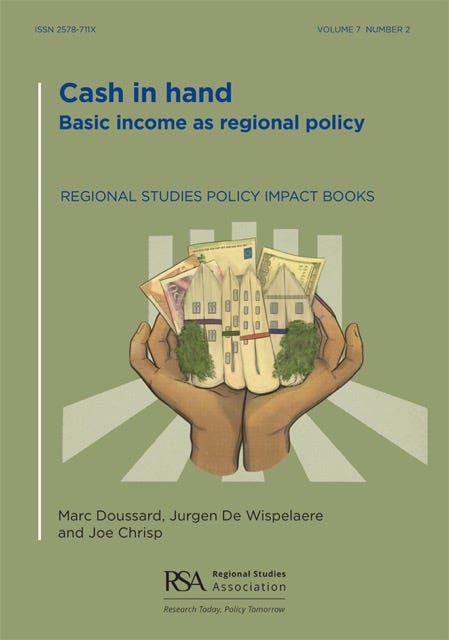
New publication: Marc Doussard, Jurgen De Wispelaere and Joe Chrisp, Cash in Hand: Basic income as regional policy
In a new publication, Cash in Hand, Marc Doussard, Jurgen De Wispelaere and Joe Chrisp make the case for basic income as a policy solution that reinvigorates left-behind places. Featuring a foreword by Olivier De Schutter, UN Special Rapporteur on extreme poverty and human rights.
Often only viewed as a national policy, recent initiatives and debates open up the idea of basic income being introduced by municipalities and regions. In the regional policy world, the long-term failure of regeneration schemes focused on manufacturing and innovation has led to a focus on endogenous development: Regional dynamism achieved by maximising the talents and contributions of existing residents. The fit between basic income and this agenda is more than aspirational. Worldwide, regions and municipalities are leading the way in experimenting with basic income and other unconditional cash transfers. Cash in Hand guides readers through the theory, evidence and practical politics of basic income as regional policy.
Cash in Hand will be launched at the BIEN Congress in Toronto (20-22 August 2026), with Marc Doussard and Jurgen De Wispelaere in conversation with Amy Castro, Tom Cooper, Fabienne Hansen and Vibhor Mathur. Join us if you are in Toronto!
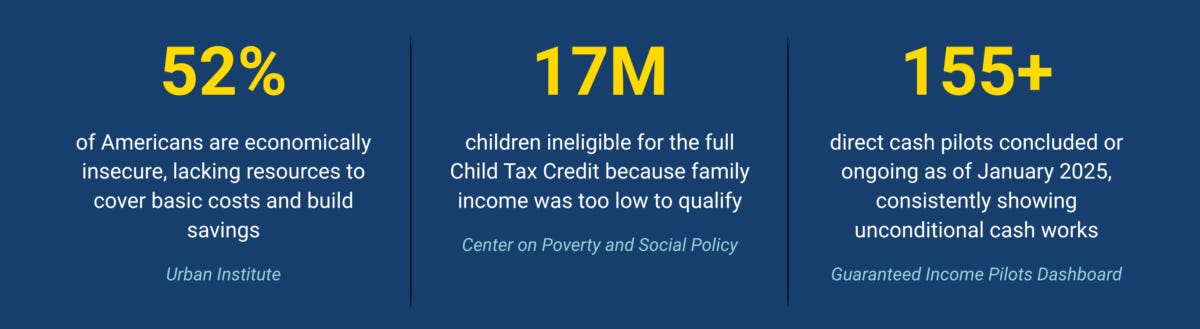
A Living Wage Floor: A generation of direct cash evidence, and the bet that turns it into a foundation every working-age household can count on.
THE BET IN BRIEF
Families should be able to work, care for each other, and build toward a future without the constant threat of financial collapse. But the labour market—defined by low wages, volatile income, and eroding employer benefits—no longer delivers that foundation for a growing share of working households. A generation of direct cash pilots has proven that an unconditional living wage floor works. Now the bet is to build one, and philanthropy is uniquely positioned to catalyse the research, state-level pilots, and systems needed to turn that proof into policy at scale.
The bet is specific: use philanthropic capital to catalyse policy research, state-level pilots, and purposeful administrative systems needed to establish a living wage floor—a regular, unconditional, sufficient cash transfer to ensure security for working-age households that does not depend on employment status, program compliance, or bureaucratic gatekeeping.
The Inclusion Crisis: Exploring a Disability-Inclusive Basic Income as a Tool for Empowerment
A Discussion Paper prepared for the BIEN 2026 World Congress, Roundtable by Jamie Cooke and Jurgen De Wispelaere
10 years of UBI pilots carried out around the world have seen basic income being tested on a wide range of individuals and groups. This allows us to go beyond simple aggregate effects to get a better and more nuanced picture of how exactly a basic income impacts people from very diverse backgrounds and lived experiences. Each study contributes to better understanding the role basic income plays as a robust policy instrument with a wide positive impact.
To our knowledge, no pilot has specifically examined the impact of basic income on people with intellectual and developmental disabilities (IDDs). There are good reasons to think that basic income would offer important support to IDD individuals and their families — but we are still awaiting the evidence.
In the past year, BIEN and Inclusion International, the international network of people with intellectual disabilities and their families, have started to explore synergies, shared views and common interests, and the potential of future collaboration.
As a first step, we will host a roundtable at the upcoming BIEN Congress in Toronto on “The Inclusion Crisis: Exploring a Disability-Inclusive Basic Income as a Tool for Empowerment”. The panel will discuss the idea of an inclusive basic income with representatives of both our communities.
We are Eight, a Belgian nonprofit that has been providing a basic income to vulnerable families and individuals in Africa for ten years.
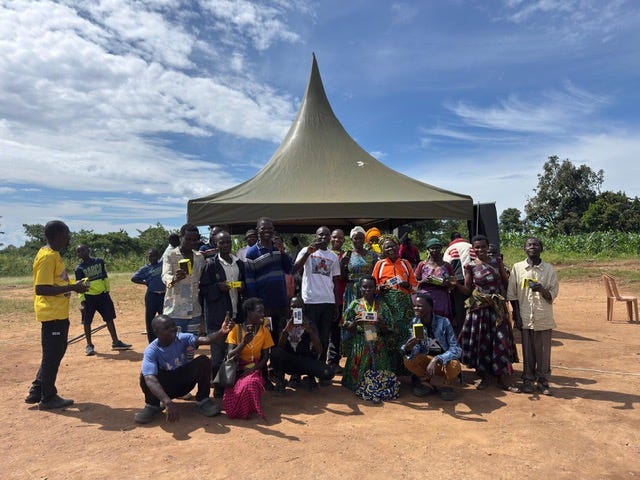
Eight gives people control of their own lives through unconditional cash transfers. Communities in Uganda, Ivory Coast, and the Democratic Republic of the Congo receive monthly support via Mobile Money for two years, which they can spend freely according to their needs. This scientifically monitored approach leads to a better quality of life, greater opportunities for women, and sustainable development. We are pleased to announce another project launch in May in West Uganda in Waol Kucan.
Waol Kucan is a coffee-growing community near the Ndhew washing microstation in Nebbi. This project is a collaboration with This Side Up and Zombo Coffee, both partners in the coffee value chain.
Over the next two years, 92 adults and 127 children will participate in the cash transfer project.
Adults receive 16€ per month, and children receive €8 per month (through their mother or female guardian).
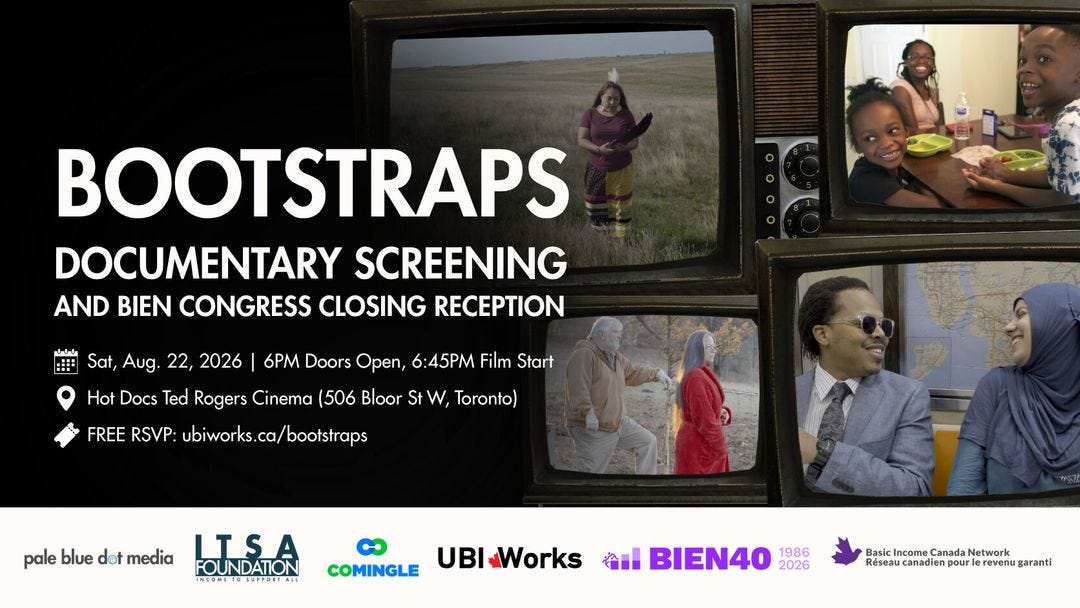
A First Look and a Basic Income Launch Party
Join us Saturday, August 22, 2026 at the Hot Docs Ted Rogers Cinema for a night at the movies and a proper celebration.
Ten years in the making, Bootstraps is a documentary series by Emmy-winning filmmaker Deia Schlosberg that followed eleven households through a multi-year basic income experiment. This is the first look at the finished series, with two episodes on the big screen, followed by a discussion with the filmmakers and some big news from ITSA Foundation and Comingle.
Come for a fun night. Free to attend, with food at the reception and great opportunities to mingle. When the cinema closes, the night carries on at a nearby pub.
BASIC INCOME RAFFLE
On August 22, UBI4ALL will raffle off another 9,600 EUR as Unconditional Basic Income. In the course of the BIEN 2026, the international Basic Income conference in Toronto, one among the UBI4ALL community of more than 45,000 people worldwide will win one to five years of Basic Income. It will be paid out monthly at 800 EUR for one year for a winner residing in a rich state (e.g. Canada, Germany, etc) or 160 EUR for five years for someone residing in a low-income country (e.g. Haiti, Bangladesh, etc) and graded accordingly in between.
Everyone aged 16 years is eligible to register on the UBI4ALL website, which is free of course, and participate in the raffle. So far, there are 9 winners from various countries worldwide. The raffle pot is funded 100% through crowdfunding; donations are welcome. Since 2020, the small UBI4ALL team has worked on a volunteer basis.
The purpose of the raffles is to introduce as many people as possible to the topic, provide a platform for discussion, and learn from the winners’ experiences.